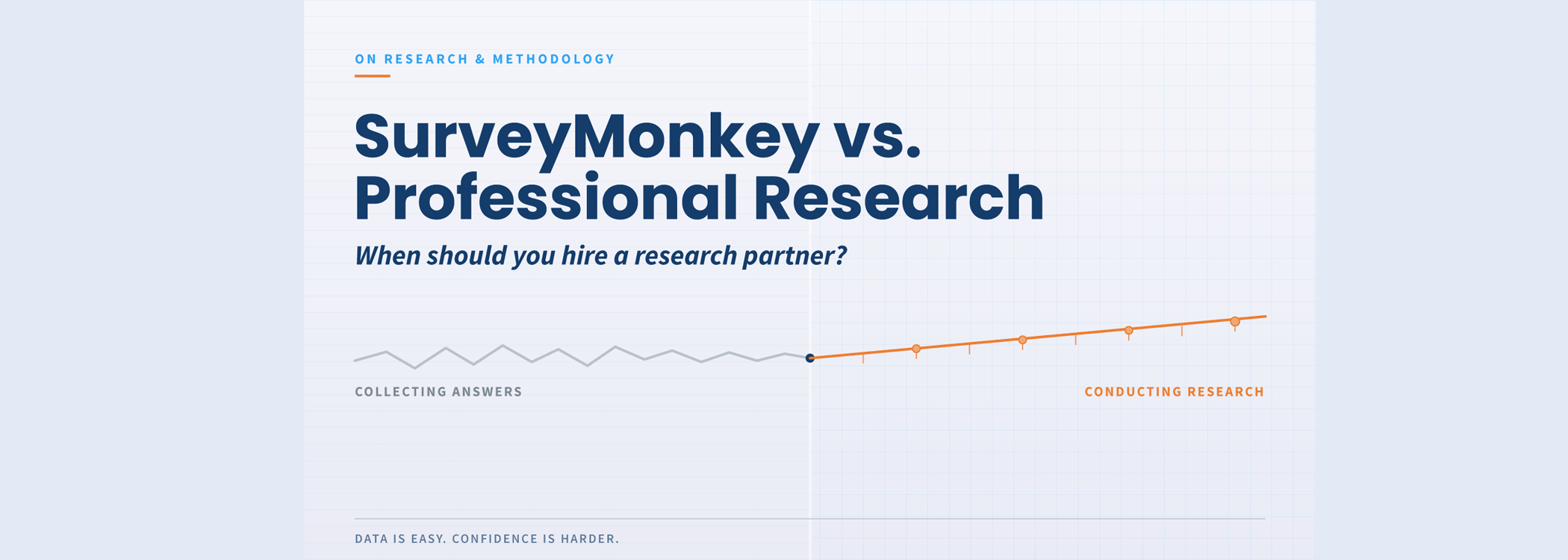
A survey can be easy to launch and still be difficult to do well. Here is how to know when a DIY survey is enough and when professional research is worth the investment.
When a team needs customer or market feedback, the instinct is often straightforward: open SurveyMonkey, write some questions, send a link and start collecting responses.
And sometimes, that is exactly the right approach.
SurveyMonkey and other self-service survey platforms have made it faster and easier than ever to gather feedback. If you need to run an internal poll, collect event feedback or get a quick directional read from your customers, you may not need a research firm at all.
But there is an important distinction that often gets lost in the conversation:
 Running a survey and conducting research are not the same thing.
The real question is not whether you can build the survey yourself. It is whether the research is important enough that you need someone to ensure the answers are reliable, the audience is appropriate, the methodology is sound and the conclusions are defensible.
And that has very little to do with which survey platform you use.
Is SurveyMonkey Enough for Market Research?
It can be, depending on the research question and the consequences of getting the answer wrong.
For low stakes or highly directional research, a DIY survey can be a smart and efficient choice. If you are testing a subject line, gathering employee feedback or asking customers how satisfied they were with an interaction, there is often little reason to bring in an outside research partner.
But when research will influence a significant business decision, the survey itself is only a small part of the equation.
You also need to consider:
- Who should answer the survey?
- How should those respondents be recruited?
- Is the sample appropriate for the question being asked?
- Are the questions unbiased and measuring what you intend them to measure?
- Are respondents qualified, engaged and unique?
- How should the data be analyzed?
- Are differences between groups meaningful?
- What conclusions can, and cannot, reasonably be drawn from the findings?
Survey software helps you collect answers. It does not replace the expertise required to determine whether those answers are worth trusting.
The question is not “Can we run this survey ourselves?” It is “How much does it cost us if the research is wrong?”
DIY Survey vs. Professional Research: What Is the Difference?
The biggest difference is not the software.
It is who is responsible for the research process.
With a DIY survey, your team owns the methodology, questionnaire design, audience selection, fieldwork, quality control and interpretation.
With a professional research partner, those responsibilities are shared with or managed by researchers whose job is to think about those things every day.
That distinction matters even when the survey itself is simple.
A 10-question survey can still have a poorly worded question. It can still reach the wrong audience. It can still attract inattentive respondents. And it can still produce findings that are technically accurate but misleading when taken out of context.
Professional research is designed to address those risks before they become conclusions.
The Survey Is Only One Part of the Research
Think about a research project as a chain:
Research objective → Methodology → Audience → Questionnaire → Fieldwork → Quality control → Analysis → Insight
The survey is only one link.
A professional research organization brings expertise to every stage.
- Research methodology
Before writing a single question, researchers consider what the study actually needs to accomplish.
- Is a quantitative survey the right methodology?
- How many responses are needed?
- What audience should be represented?
- Are quotas necessary?
- Should the data be weighted?
- What level of precision is required?
These decisions help determine whether the study will actually answer the business question, not simply generate a collection of percentages.
- Questionnaire design
Good survey questions are not necessarily complicated questions.
They are questions that are clear, unbiased and designed to generate useful information.
Researchers look for issues such as:
- Leading or loaded language
- Double barreled questions
- Missing answer options
- Poor question sequencing
- Unnecessary assumptions
- Ambiguous terminology
- Questions that do not directly support the research objective
A survey platform can tell you whether your questionnaire functions technically.
A researcher can help determine whether it works as research.
- Audience and sampling
Who answers the survey can matter just as much as what you ask them.
Imagine you want to understand how business leaders are approaching AI.
You could send your survey to 500 people and get 500 responses.
- But are they actually business leaders?
- Do they work in the industry you are studying?
- Do they have the experience or responsibilities required to answer the questions?
- Are they unique respondents?
- Are they representative of the population you are trying to understand?
Five hundred responses from the wrong people are not necessarily better than 100 responses from the right people.
Professional research organizations can bring access to vetted audiences, panel partners and recruitment methodologies that go beyond simply sending a survey link to an existing email list.
At EBI, audience quality is a fundamental part of our research process. We leverage proprietary audiences across EndeavorB2B’s industry portfolio and, when external panelists are needed, work with vetted sample providers.
- Data quality
This is one of the most important and least visible parts of professional research.
A respondent can technically complete a survey without providing useful data.
- They may rush through the questionnaire.
- Select the same answer repeatedly.
- Fail an attention check.
- Submit a duplicate response.
- Provide nonsensical open ended answers.
- Or use AI to generate responses that look legitimate at first glance.
That is why EBI applies multiple layers of quality control throughout the research process, including duplicate and identity controls, attention checks, AI response detection, straight lining and response pattern analysis, speeding checks and manual review of open ended responses.
The objective is not to make research more complicated.
It is to make the resulting data more trustworthy.
“It Is Only 10 Questions. Why Not Just Use SurveyMonkey?”
You can.
Sometimes that is exactly the right call.
If you are conducting a quick check with a known group, collecting event feedback or running an internal poll, a self service survey tool may be all you need.
 But here is the important distinction:
A short survey is not necessarily a simple research project.
Even a 10 question survey can introduce meaningful risks:
- The wrong audience
- Biased or leading question wording
- Duplicate or inattentive respondents
- An insufficient or unrepresentative sample
- Analysis that misses a meaningful difference between audience segments
- Conclusions that go further than the data actually supports
None of those problems require complicated survey logic.
And none of them are solved simply by having more sophisticated survey software.
That is the line between survey software and research expertise.
The number of questions does not determine the rigor your research requires. The importance of the decision you are making with the results does.
If you are using the findings to make a meaningful business decision, even a short survey deserves careful consideration of the audience, methodology, questionnaire design, data quality and analysis.
Where Does Forsta Fit In?
This is where the conversation can easily become Forsta vs. SurveyMonkey.
But that is not really the comparison.
Forsta is professional research infrastructure. It gives EBI’s research team the environment to design, program, field and manage studies ranging from straightforward surveys to highly sophisticated research projects.
But a research firm is not valuable simply because it has access to Forsta.
It is valuable because it knows how to conduct research, and Forsta is one of the tools it uses to do that well.
The platform does not determine the research methodology. It does not decide whether your sample is appropriate. It does not know whether a question is subtly leading respondents toward an answer. And it does not determine whether a finding is meaningful in the context of your business.
The platform doesn’t do the thinking. The researcher does.
That is worth separating clearly:
You are not hiring a research firm because it has Forsta. You are hiring a research firm because it knows how to conduct research, and Forsta happens to be one of the environments it uses to do that work.
The technology supports the process.
It does not replace the thinking behind it.
What Does a Research Firm Do That Survey Software Does Not?
A research firm does more than provide access to a survey platform.
A professional research partner can provide:
Methodological expertise. Researchers determine the appropriate methodology, sampling approach and study design for the business question.
Unbiased questionnaire development. An outside research team brings an objective perspective and can identify wording, sequencing or answer choice issues that an internal team may overlook.
Audience expertise. Professional researchers can help identify, recruit and qualify the right respondents rather than simply reaching whoever happens to be available.
Data quality controls. Research teams can apply multiple checks designed to identify duplicate, fraudulent, inattentive or otherwise problematic responses.
Analysis and interpretation. Researchers do not stop at reporting percentages. They examine patterns, segments and relationships in the data and put the findings into context.
An outside perspective. Internal teams naturally bring valuable institutional knowledge. But they can also bring assumptions about what the research should say. An independent research team can provide a useful counterbalance.
Accountability. When research is going to be presented publicly or used to make an important business decision, having an experienced research partner stand behind the methodology adds another layer of confidence.
When Does DIY Make Sense and When Does It Not?
Professional research is not automatically the right answer for every survey.
In fact, there are plenty of situations where doing it yourself is perfectly reasonable.
DIY survey tools are usually a good fit when:
- The audience is a known, defined group
- The results are primarily for internal use
- The findings are directional rather than decision critical
- Speed and budget matter more than methodological rigor
- Your team has the expertise to design and interpret the survey
In those situations, a tool like SurveyMonkey can be a practical, efficient way to get answers quickly.
A professional research firm should not tell you otherwise.
A professional research partner is worth considering when the findings will:
- Shape business strategy or product direction
- Inform marketing or positioning decisions
- Support thought leadership or public benchmarking
- Influence executive or investment decisions
- Be shared publicly with customers, prospects or the press
- Require a specific, hard to reach or representative audience
- Need rigorous segmentation, weighting or statistical analysis
- Need to stand up to scrutiny from internal or external stakeholders
The dividing line is not necessarily the size of the survey.
It is the stakes of the decision you are making with the results.
When the cost of getting the research wrong is significant, the cost of professional research may be a lot easier to justify.
The Hidden Cost of DIY Research
The biggest misconception about DIY research is that the cost is the survey software subscription.
It is not.
The real cost is the potential cost of making a decision based on bad information.
Imagine investing months and significant resources into a new product based on a survey that unintentionally sampled the wrong audience.
Or changing your positioning based on questions that subtly led respondents toward the answer your team expected.
Or publishing a thought leadership report based on responses that included a meaningful number of low quality or fraudulent participants.
The survey itself may have cost very little.
The decision based on it could cost considerably more.
That is why the right question is not simply:
“How much does it cost to conduct this survey?”
It is:
“How much does it cost to get this decision wrong?”
The Work Does Not End When the Survey Closes
Getting responses is not the finish line.
It is the beginning of the analysis.
A professional research team does not simply deliver a spreadsheet and say, “Here is what people said.”
We look at the data from multiple angles.
Are there meaningful differences between audience segments?
Are certain findings statistically meaningful, or are they simply differences that could occur by chance?
Do the findings tell a consistent story?
Are there unexpected results worth exploring?
What does the research tell us about the broader market?
And ultimately:
 What does the client do with what we have learned?
That is where data becomes insight.
Data Collection Is Easy. Good Research Requires Expertise.
Technology has democratized data collection, and that is a good thing.
Organizations can get closer to their customers and audiences without always needing a large research budget or a formal research engagement.
But easier data collection does not eliminate the need for research expertise.
It makes knowing what to do with that data even more important.
A survey platform can help you ask questions.
A professional research organization helps ensure you are asking the right questions, of the right people, in the right way, and interpreting the answers appropriately.
That is the difference between collecting data and conducting research.
And when the answer matters, that difference matters, too.
Have a research question you are trying to answer?
You do not always need a large scale research program. EBI can help you determine whether your project calls for a quick pulse survey, a more rigorous quantitative study, qualitative research or something in between.
Start with the question. We will help you determine the right way to answer it.
Frequently Asked Questions
Is SurveyMonkey good for market research?
SurveyMonkey can be an effective tool for simple, low stakes or directional research. However, the platform itself does not replace research expertise. For market research that requires a qualified audience, rigorous methodology, respondent quality controls, statistical analysis or defensible conclusions, working with a professional research organization can provide additional value.
What is the difference between a DIY survey and professional market research?
A DIY survey typically means an organization manages the research process internally, from questionnaire design and audience selection through fielding and analysis. Professional market research adds experienced researchers who can help determine the appropriate methodology, design unbiased questions, recruit and qualify the right audience, monitor data quality, analyze results and interpret the findings.
Is Forsta better than SurveyMonkey?
Forsta and SurveyMonkey serve different needs, and the more important question is not which platform is universally better. SurveyMonkey can be an excellent choice for straightforward self service surveys, while Forsta is designed to support professional research workflows. For organizations working with a research partner like EBI, the value comes from combining research expertise, methodology, audience access, quality controls and analysis with professional research technology.
When should a company hire a market research firm?
A company should consider hiring a market research firm when research will influence an important business decision, require a specific or hard to reach audience, be shared publicly, support thought leadership, or require advanced analysis or methodological expertise. The higher the cost of making the wrong decision, the more valuable professional research expertise can become.
How does a research firm ensure survey respondents are legitimate?
Professional research organizations use multiple methods to evaluate respondent quality. Depending on the study, these can include respondent qualification, duplicate and identity controls, attention checks, speeding analysis, response pattern analysis, AI response detection and manual review of open ended responses. These safeguards help reduce the risk of low quality or fraudulent responses affecting research findings. You an read more about our research practices here.
Does a small or simple survey need a research firm?
Not necessarily. A simple survey can be appropriate for DIY research when the question is low stakes, the audience is readily available and the results are primarily directional or internal. The complexity of the questionnaire is not the only factor to consider. Even a short survey can benefit from professional research expertise when the findings will inform an important business decision.
Is a larger sample size always better?
No. A larger sample does not automatically produce better research. The quality and relevance of the respondents, the sampling approach, questionnaire design and data quality controls are also critical. In many cases, a smaller sample of appropriately qualified respondents can be more useful than a larger sample of poorly matched participants.
What does a professional research firm provide beyond survey software?
A professional research firm can provide research methodology, questionnaire design, audience targeting and recruitment, respondent quality controls, fieldwork management, data analysis, interpretation and strategic insight. Survey software is one component of that process. The expertise surrounding the technology is what turns collected responses into actionable research.